
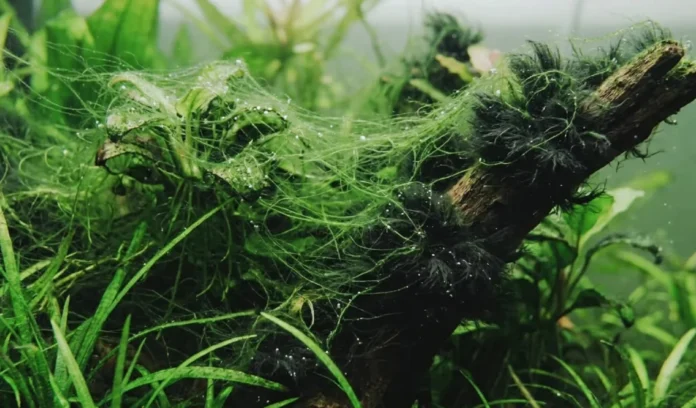
Have you recently set up a new aquarium and noticed green growth on the hardscape or plants? Or is the substrate covered with a brown or greenish layer with a strong smell? Then you most likely have a small algae problem.
However, algae are not always a bad sign. During the cycling phase, many types of algae are completely normal and often disappear on their own once the aquarium becomes more stable. If algae suddenly appear in an established aquarium, the reason is often an imbalance between nutrients, lighting and overall tank conditions.
In this article, I will introduce you to 7 of the most common types of aquarium algae, show you how to identify them and explain some of the common reasons why they appear.
The most common algae in aquariums are green dot algae, black beard algae, green water, thread algae, brown algae, staghorn algae and blue-green algae.
Green dot algae
Green dot algae form small, hard and dark green dots on solid surfaces such as rocks, driftwood, aquarium glass and the leaves of broad-leaved aquarium plants.
A few individual spots are usually not a serious problem and can be completely normal. A larger outbreak of green dot algae is often linked to a low carbon supply in the form of CO2. An insufficient supply of macronutrients, especially phosphate, can also encourage the growth of green dot algae.
Black beard algae
Black beard algae belong to the red algae group. They have a very dark, brush-like appearance, with colors ranging from dark green to almost completely black.
They often attach very firmly to aquarium equipment such as filter outlets, as well as hardscape like rocks and driftwood. They can also appear along the edges of plant leaves.
In fish tanks, black beard algae are often connected to a high organic load. This can happen because of overfeeding, heavy stocking or too few water changes. As a result, waste and
debris can build up in the substrate and filter and create favorable conditions for this type of algae.
Low or unstable CO2 levels can also play a role. In aquascaping tanks, black beard algae can also appear when the balance of micronutrients is not ideal. In this case, it can be useful to check the amount of iron fertilizer being added.
Green water
Green water is caused by tiny floating algae that give the aquarium water a green color. In a short amount of time, the water can become so cloudy that visibility inside the tank is strongly reduced.
Different types of green algae, including species from the genera Chlorella and Ankistrodesmus, can be involved.
Green water can appear after strong temperature increases, for example during summer, or when the aquarium receives too much light. An imbalance involving carbon and macronutrients can also encourage an outbreak.
This type of algae is also common during the cycling phase, when the ecological balance of the aquarium has not fully developed yet.
Large water changes can help reduce green water. A UV-C clarifier can also be a very effective way to remove floating algae from the water.
Thread algae
Thread algae are very common during the cycling phase of an aquarium. They are easy to recognize because they form very fine, long and soft threads.
The algae are usually loose enough to be removed by hand and can easily be wrapped around a wooden stick or skewer. They are also a popular food source for several algae eaters, including Amano shrimp.
If thread algae suddenly appear in an established aquarium, strong lighting can be one possible reason. This can happen during summer or after changing to a more powerful aquarium light.
Low nitrate levels and an insufficient CO2 supply can also encourage the growth of thread algae.
Brown algae
In the aquarium hobby, brown algae usually refers to diatoms. They form soft brown coatings that do not attach very strongly and often appear on rocks, aquarium glass and plant leaves.
Brown algae are often among the first algae to appear in a newly set-up aquarium. As the tank matures, they are often replaced by different types of green algae.
If brown algae continue to appear in an established aquarium or do not disappear after the cycling phase, elevated silicate levels in the water can be one possible reason.
Snails and shrimp usually enjoy eating these algae, which makes them relatively easy to control in many aquariums.
Staghorn algae
Staghorn algae belong to the red algae group and are easy to recognize because of their unusual shape. Their branching growth looks similar to the antlers of a deer, which is where the name comes from. Their color can range through different shades of gray.
If you place this algae in alcohol, it can turn clearly red. This can help confirm that it belongs to the red algae group.
Staghorn algae usually attach quite firmly to aquarium decorations, equipment and the edges of aquatic plant leaves. Because of this, many algae eaters are not very interested in them.
In planted aquariums, staghorn algae can sometimes appear when micronutrient fertilizer, especially iron fertilizer, is added in very high amounts.
Blue-green algae
Unlike the other types in this article, blue-green algae are not actually algae. They are cyanobacteria, but in the aquarium hobby they are commonly treated and discussed as algae.
Blue-green algae usually form a slimy, dark green to blue-green layer that can slowly spread across the substrate, plants and even the aquarium glass.
One of the easiest ways to identify them is their strong and unpleasant smell. The layer can usually be removed very easily, but shrimp and snails generally do not eat it.
An outbreak of blue-green algae can be connected to a nutrient imbalance. High phosphate levels combined with low nitrogen levels are often mentioned as one possible factor.
An unstable or disturbed microbial balance in the aquarium can also encourage cyanobacteria to appear.
Algae are part of almost every aquarium and do not automatically mean that something is wrong. Especially during the cycling phase, small amounts are completely normal.
Correct identification helps you understand whether you should take action or simply give the aquarium more time to become stable. Instead of only treating the visible algae, it is usually better to look at the complete system, including lighting, CO2, nutrients, maintenance and the overall stability of the tank.
